MEMENTO MORI · SERA NIMIS VITA EST CRASTINA VIVE HODIE · NON EST VIVERE SED VALERE VITA EST · HOMINEM PAGINA NOSTRA SAPIT · SVMMVM NEC METVAS DIEM NEC OPTES · HOC EST VIVERE BIS VITA POSSE PRIORE FRVI · MEMENTO MORI · QVOD SIS ESSE VELIS NIHILQVE MALIS · SPQR
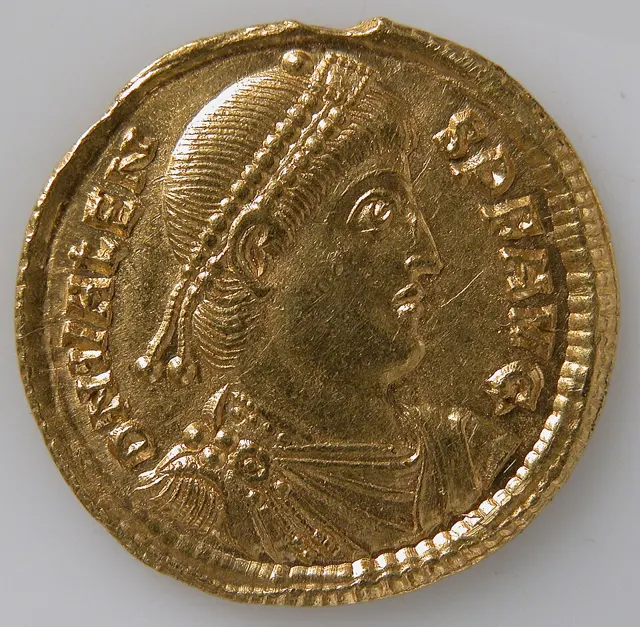
On 9 August 378 the Goths destroyed the eastern Roman army near Adrianople; the emperor Valens died, his body never found, and only a third of the army escaped.
Exoriente vero aurora diei, quem quintum Iduum Augustarum numerus ostendit annalis, signa praepropere commoventur
At the break of dawn on the day which the calendar marks as the fifth before the Ides of August, the standards were moved forward in great haste.
Background
In 376 large groups of Goths, fleeing the Huns, were allowed to cross the Danube into Roman territory. Mistreated by Roman officials and short of food, they rebelled and plundered Thrace. In 378 the eastern emperor Valens marched against them from Adrianople, unwilling to wait for his nephew Gratian and the western army.
Ammianus describes the day per Ammianus. At dawn on the fifth day before the Ides of August the army set out in haste, and around the eighth hour, in the heat of the day, sighted the Goths' circle of wagons. The battle turned into a massacre. As darkness fell Valens was struck by an arrow among the common soldiers and died; his body was never found. Others reported that he was carried to a farmhouse, which the Goths burned without knowing who was inside. Thirty-five tribunes fell, along with many senior officers. "Scarcely one-third of the whole army escaped."
Ammianus, who ends his history with this battle, says that except for Cannae no such slaughter was recorded in Roman annals. Historians often treat Adrianople as a turning point: from then on, Gothic peoples lived inside the empire as semi-independent allies disputed.
Ancient source: Ammianus Marcellinus 31.12–13 · Reference
a.d. V Id. Aug.· Roman date in the pre-Julian calendar (day inferred, not written in the source)
Two Roman stone calendars mark 9 August as a holiday because on that day Caesar won at Pharsalus; Caesar says Pompey’s camp was found full of silver and ivy-covered tents.
Feriae quod eo die C. Caesar C. f. Pharsali devicit
Holiday, because on this day Gaius Caesar, son of Gaius, was victorious at Pharsalus.
Background
In 49 BC Julius Caesar crossed the Rubicon, and Pompey and most of the senate left Italy to fight him from the east. After a setback at Dyrrachium, Caesar marched into Thessaly, and the two armies met on the plain near Pharsalus. Pompey had more men and far more cavalry.
Caesar's own account tells how his reserve line of cohorts broke Pompey's cavalry charge, and the Pompeian army collapsed per Caesar. He says he lost no more than two hundred soldiers but about thirty brave centurions. About fifteen thousand Pompeians seemed to have fallen, more than twenty-four thousand surrendered, and 180 standards and nine eagles were brought to him. Caesar also describes what his men found in Pompey's camp: arbours built for dining, a great weight of silver plate set out, tents laid with fresh turf, and some covered with ivy, signs of luxury and of an army sure of victory. Pompey took off his general's insignia, rode out of the back gate and fled toward Larisa; he would be killed in Egypt weeks later.
After Caesar's heir became Augustus, Italian towns put the victory into their stone calendars. The Fasti Amiternini mark the day as a holiday "because on that day Gaius Caesar, son of Gaius, was victorious at Pharsalus".
Before Caesar's reform (45 BC) the calendar had drifted from the seasons, so the real seasonal date was different; we don't give a modern equivalent. Why?
Ancient source: Fasti Amiternini and Fasti Allifani (9 August); Caesar, Civil War 3.88–99 · Reference
☁ Rome today (1991–2020 avg): 31°/21°C (88°/70°F) · rain 14% of days
Rome in AugustThe hottest weeks raised the risk of fire in the dense city, especially in…
Fields & crops
Columella marks autumn beginning around 12 August; straw and stubble were gathered, figs and early fruit picked, and vineyards readied for the vintage per Columella 11.2.
Courts & law
A quieter legal month; many elite Romans were in the countryside. Under the empire, the imperial household's slaves and freedmen kept administration running.
Senate & politics
Renamed from Sextilis in 8 BC for Augustus, who had won his greatest successes in this month, including the capture of Alexandria in 30 BC per Macrobius 1.12.35.
Military
Armies stayed in the field; disease in hot camps was often as dangerous as battle modern view based on ancient accounts.
Festivals & religion
Portunalia (17 Aug.), Vinalia Rustica (19 Aug.), Consualia (21 Aug.), Vulcanalia (23 Aug.), when small fish were offered to Vulcan to ward off fire, and Opiconsivia (25 Aug.) per Varro and Festus. On the Ides, Diana's day, enslaved people had a holiday per Festus and Plutarch.
Daily life
The hottest weeks raised the risk of fire in the dense city, especially in timber-framed insulae; Augustus set up the vigiles, a fire brigade of freedmen, in AD 6 per Suetonius and Dio. Fevers peaked in late summer and early autumn; the sick poor relied on home remedies and shrines more than on doctors modern view.